
6
Stepping into a poker room requires more than just a bankroll; it demands an absolute, subconscious fluency in the hierarchy of the cards. The difference between a recreational player and a profitable grinder often lies in how quickly they can process the strength of their holding relative to the community cards. Memorizing the standard poker hand rankings is merely the baseline. The true complexity of Texas Hold’em emerges when you must evaluate those rankings in the heat of a hand, factoring in board texture, opponent tendencies, and mathematical probability. To truly master the game, you must move beyond a static list and examine how these hand rankings function in practical, real-world betting scenarios.
The Foundational Hands: High Card and One Pair
At the bottom of the poker hierarchy sit the hands that will account for the vast majority of your playing time. In a standard game of Texas Hold’em, you will frequently reach the river without connecting with the community cards in any meaningful way. Navigating these low-value hands separates disciplined players from chronic gamblers.
High Card Dynamics
When no player at the table manages to formulate a paired hand or better, the pot is awarded to the player holding the highest single card. The absolute lowest possible winning hand relies entirely on this metric.
Imagine you are in late position holding an Ace-Queen of Hearts. The community board runs out completely disconnected: a Two of Clubs, Five of Spades, Nine of Diamonds, Jack of Clubs, and Four of Spades. Neither you nor your opponent has a pair. If the hand goes to a showdown, your Ace high will win the pot if your opponent is holding a hand like King-Queen. In practical play, winning at showdown with an Ace high is common in heads-up situations, but relying on a high card in a multi-way pot is a fast track to depleting your chips.
The Power and Vulnerability of One Pair
One pair is formed when you match one of your hole cards with a community card, or when you are dealt a pocket pair. Not all pairs are created equal. The concept of the kicker—your unpaired hole card—becomes the defining factor in these scenarios.
Suppose you are dealt an Ace-King of Spades, and the flop comes King-Seven-Two. You now hold top pair with top kicker. This is a premium holding on the flop, allowing you to bet aggressively for value against players holding weaker Kings, like King-Jack or King-Ten. However, one pair is a vulnerable hand. If the turn brings a straight or flush draw to the board, your top pair instantly transitions from a powerhouse into a marginal hand that requires strict pot control.
Escalating the Tension: Two Pair and Three of a Kind
As we move up the ranking ladder, the hands become significantly stronger and capable of winning large pots. However, the exact way these hands are constructed dramatically alters their practical value.
Two Pair Vulnerabilities and Counterfeiting
Two pair occurs when both of your hole cards match two different cards on the board, or when the board itself contains a pair that matches one of your hole cards.
Consider a scenario where you hold Ace-Jack and the flop arrives Ace-Jack-Five. You have flopped top two pair, a massive hand that warrants heavy betting. But two pair comes with a unique structural vulnerability known as counterfeiting. If the turn is a Five, the board now reads Ace-Jack-Five-Five. While you still technically have two pair (Aces and Fives), any opponent holding a single Ace with a higher kicker than your Jack (such as Ace-King) now beats you, because their best five-card hand is Aces and Fives with a King kicker.
The Hidden Strength of a Set
Three of a kind sits above two pair, but seasoned players draw a massive distinction between trips and a set. Trips occur when the board is paired and you hold a third matching card (e.g., holding an Eight when the board is Eight-Eight-Two). A set occurs when you hold a pocket pair and a third matching card hits the board (e.g., holding pocket Sevens on a Seven-Two-Queen flop).
A set is widely considered the most profitable hand in No-Limit Hold’em because it is perfectly disguised. When the flop comes Seven-Two-Queen, an opponent holding Ace-Queen believes they have the best hand and will frequently commit their entire stack. Because your pocket Sevens are completely hidden, you can extract maximum value from their top pair.
The Mid-Tier Powerhouses: Straights and Flushes
When you cross the threshold into straights and flushes, you are dealing with premium hands that can confidently play for a player’s entire stack. These hands rely heavily on reading the overall texture of the community cards.
Navigating the Straight
A straight consists of five cards in sequential order of varying suits. The highest possible straight is the Ten-Jack-Queen-King-Ace, known as Broadway.
The practical application of playing a straight relies on understanding relative hand strength. Suppose you hold Eight-Nine of Clubs and the board runs out Five-Six-Seven of Hearts. You have successfully hit your straight. However, because there are three Hearts on the board, your straight is mathematically vulnerable to any opponent holding two Hearts in their hand for a flush. Recognizing when your straight is the absolute “nuts” (the unbeatable hand) versus when it is a secondary hand dictates whether you should be shoving all-in or checking to control the size of the pot.
The Flush and Board Texture
A flush consists of five non-sequential cards of the exact same suit. When evaluating a flush, the rank of your highest suited hole card determines your strength.
If you hold the Ace-Jack of Spades and the board contains three Spades, you possess the nut flush. No other player can have a higher Spade flush because you hold the Ace. This is a dream scenario. The strategic objective shifts from winning the hand to figuring out exactly how much your opponent is willing to pay to see your cards. Conversely, if you hold the Four-Five of Spades on that same board, you have a baby flush. You must play defensively, as any heavy betting from an opponent likely indicates they hold a higher Spade.
The Premium Holdings: Full Houses and Four of a Kind
When you reach the top tier of standard poker hands, the mechanics of the board dictate everything. These hands are statistically rare and usually result in the largest pots of the evening.
The Mechanics of the Full House (The Boat)
A full house consists of three of a kind combined with a pair. The golden rule of poker strategy is that a full house is only mathematically possible if the community board has a paired card.
Imagine you turn the nut flush holding the Ace-King of Diamonds on a board showing Three-Seven-Nine-Jack, all Diamonds. You confidently bet large. But the river falls as the Jack of Spades, pairing the board. Suddenly, the dynamic shifts entirely. An opponent who had a set of Nines or pocket Jacks has just improved to a full house or better, mathematically crushing your flush. Recognizing when the board pairs is the single most important defensive skill when you hold a flush or a straight.
Four of a Kind (Quads)
Four of a kind is an exceptionally rare monster. Holding four cards of the same rank makes you virtually invincible in standard play.
If you hold pocket Queens and the flop comes Queen-Queen-Four, you have flopped quads. The practical playing example here revolves entirely around psychological deception. If you bet heavily on the flop, you will force every opponent to fold, winning a tiny pot with a monstrous hand. The correct strategy is often to check, feigning weakness, and allowing an opponent to catch a pair or decide to bluff. Your goal is to keep them in the hand long enough to build a substantial pot before revealing your absolute dominance.
The Statistical Anomalies: Straight Flushes and Royal Flushes
The final two rankings on the poker hierarchy are so statistically infrequent that many recreational players go years without experiencing them.
The Straight Flush
A straight flush combines the rules of a straight and a flush: five sequential cards of the identical suit. If you hold the Six-Seven of Spades and the board brings the Eight, Nine, and Ten of Spades, you have cracked the game. This hand beats four of a kind and everything below it.
The Royal Flush
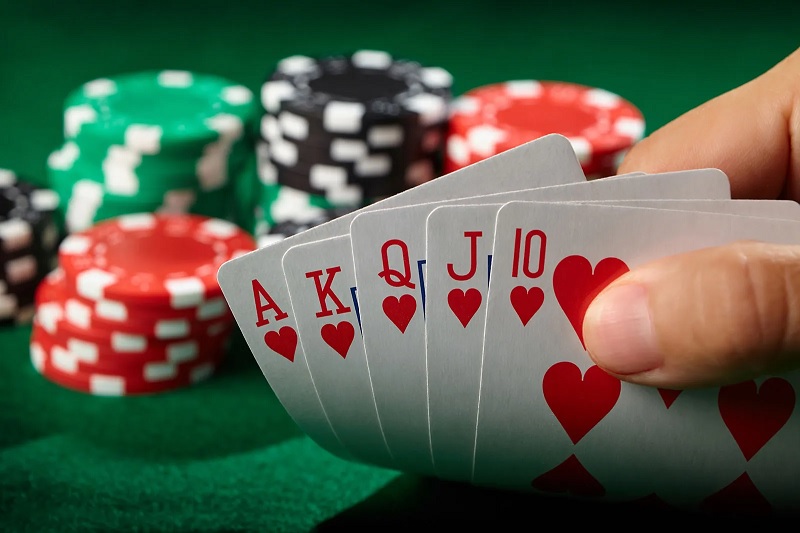
The absolute pinnacle of the game is the Royal Flush. It is a straight flush running specifically from Ten to Ace. The odds of making a Royal Flush on the river in Texas Hold’em are astronomically low—roughly 1 in 30,940. When a player achieves this, the hand plays itself. The only strategy involved is attempting to extract whatever chips the opposing players have left in front of them without scaring them away.
Ultimately, internalizing the poker hand rankings is not an exercise in rote memorization. It is about understanding the shifting mechanics of the board. A pair of Aces is a magnificent hand before the flop, but can easily become the worst hand on a board showing four cards to a straight. By applying these practical examples to your own sessions, you transform a simple list of rankings into a dynamic, defensive, and highly profitable framework for reading the game.
